vendredi 9 octobre 2009

Roxane's portrait

Thursday 8 October

Roxane


With Roxane, it’s easy - you either love her or hate her.
She can be touchy – especially when I call her the queen of shopping addicts - and admittedly she’s slightly boastful.
Most of the time, she’s lively and pleasant. Are you bored? Call her, you are sure to have fun!
But, you’d better not be her neighbour, she can talk to you for hours on end!
Like all blond girls she can be smart only when she wants.
Knock at Roxane’s door, you’ll have to step over a huge clothes heap, and you’ll inevitably find her chatting on Facebook and drinking a Coca light.
I’ve known Roxane for 10 years. Yes, she’s worth meeting.
Caroline

lundi 30 mars 2009

Saturday 29 March

Saturday 29 March
Malnutrition: the killer of India

Affecting 42.5 percent of Indian children, malnutrition is “a national shame” in the words of the Prime Minister of India, Manmohan Singh.
India’s rate of malnutrition is higher than in some African countries. Malnutrition makes children more prone to illness and stunts physical growth. Even in the capital, which has the highest per-capita income in the country, 42 percent of children under five years old are stunted, or too short for their age and 26 percent are underweight.

Amartya Sen, the Nobel prize-winning economist pointed out that malnutrition is not a political priority in India. Nevertheless India has started a 1.3 billion dollar food program in order to contain this problem.

The Ministry of Women and Child Development acknowledged that the program used to be a good thing during the last 30 years but that it is not any more adapted. The report recommended to fortify food with micronutrients and to teach parents how to better feed their babies.

Last month, a report of Food Program noted that India was the fourth hungry country of the world. Malnutrition concerns a total of 230 million people.

My point of view
I think that malnutrition is a very important issue. It’s important to see that developing countries are suffering from malnutrition while it has been eradicated for a long time in Europe.

Eva
http://www.nytimes.com/2009/03/13/world/asia/13malnutrition.html


Samedi 29 mars
La sous-nutrition fait toujours autant de victimes

Touchant 42,5% des enfants indiens, la malnutrition est «une honte nationale» selon le premier ministre Manmohan Singh. En effet, le taux de malnutrition est, en Inde, plus élevé que dans certains pays africains. La sous-alimentation rend les enfants plus fragiles face aux maladies et retarde le développement physique et intellectuel. Même dans la capitale, qui a le revenu par habitant le plus haut du pays, 42% des enfants de moins de 5 ans sont rachitiques ou trop petits pour leur âge tandis que 26% sont en sous-poids.

Le Prix Nobel d’Economie Amartya Sen fait cependant remarquer que le gouvernement ne prend pas assez au sérieux ce problème. Pourtant, l'Inde a lancé un grand programme d'alimentation, d’une valeur de 1,3 dollars afin de combattre ce fléau.

Le Ministère de Femmes et le Développement de l'enfant a reconnu que le programme avait porté ses fruits dans les 30 dernières années mais qu’il n’était plus adapté. Le rapport a recommandé de fortifier l'alimentation avec des micro substances nutritives et d’instruire les parents sur la façon de mieux alimenter leurs bébés.

Un rapport de Programme Alimentaire Mondial le mois dernier a noté que l'Inde est le 4ème pays du monde où la sous-nutrition est la plus importante : 230 millions de personnes en tout souffrent de ce fléau.

Je pense que la sous-nutrition est un phénomène qui mérite qu’on s’y intéresse. Il est important de voir que les pays à forte croissance comme l’Inde souffrent actuellement de problèmes éradiqués depuis longtemps en Europe.

Eva


mardi 10 février 2009

Muslims protest against persecutions

Thursday 29 January
Muslims protest against persecutions

Indian Muslims demonstrated in Delhi against the presumed harassment of the Muslims by police forces. A special train brought them in Delhi Thursday morning.
The train came from Azamgarh in the state of Uttar Pradesh. A lot of passengers got on board it during the journey to Delhi. The protesters arrived in Delhi brandishing banners which said "Let the truth prevail, bring the innocents out of jail" and "Give us security, not tears and blood".

Maulana Amir Rashadi, one of the organizers of the demonstration, claims that young Muslims are too often accused of being terrorists. In November, Human Rights Watch declared that the police of the state of South Andhra Pradesh should be prosecuted. It was suspected to have tortured Muslims detained after bomb blasts last year. The Watch warned the police of the risks of stigmatising and alienating "a whole community". The government of the state had admitted that 21 people had been tortured and it paid to each of these victims 600 dollars in compensation.

Joanna Jolly from BBC, in Delhi, reports that more than 2000 persons had gathered.
Amik Jamai, a film-maker who participated in the demonstration, said that “the Muslims here are proud to be patriotic, they have promoted the concept of peace here, they live in harmony” "We are hoping for justice. We are hoping for transparency."

The ultimate objective of the organizers is a meeting with the interior minister.

My point of view

I think that the conflicts between religions are inevitable. However, in this case, it is a conflict between the government and a religious community. I find that the Indian government is not very tolerant. It is however necessary to remind that the Muslims are pointed out like terrorists in a lot of countries. And that India is no exception.

Eva
http://news.bbc.co.uk/2/hi/south_asia/7857468.stm


Jeudi 29 Janvier
Les Musulmans persécutés

Des Indiens de confession musulmane ont manifesté à Delhi contre le harcèlement présumé des Musulmans par les forces de l’ordre. Un train spécial les a amenés à Delhi jeudi matin.
Le train était parti de Azamgarh dans l’état de l’Uttar Pradesh et de nombreux passagers sont montés durant le trajet jusqu’à Delhi. Les protestataires sont arrivés à Delhi en brandissant des bannières qui disaient «Laissez prévaloir la vérité, sortez les innocents de prison » et « donnez-nous la sécurité et non les larmes et le sang »

Maulana Amir Rashadi, l’un des organisateurs de la manifestation, prétend que les jeunes Musulmans sont trop souvent accusés d’être des terroristes. En novembre, l'Observatoire des droits de l'homme a déclaré que la police de l'état d'Andhra Pradesh du sud devait être poursuivie. Elle était suspectée d’avoir torturé des musulmans placés en détention après des attentats à la bombe l’année dernière. L’Observatoire a averti les policiers des risques de stigmatiser et d’aliéner "une communauté entière". Le gouvernement de l’Etat a admis que 21 hommes avaient été torturés et a versé à chacune de ces victimes 600 dollars de dédommagement.

Joanna Jolly de la BBC, à Delhi, rapporte que plus de 2000 personnes s’étaient rassemblées.
Amik Jamai, un cinéaste qui a participé à la manifestation, a déclaré à la BBC que « Les Musulmans d’ici sont fiers d’être patriotes, ils ont accepté le concept de paix ici, et tous vivent en harmonie » « Nous espérons la justice. Nous espérons la transparence »

L’objectif ultime des organisateurs est une entrevue avec le ministre de l’Intérieur.

Mon point de vue

Je pense que les conflits de religions sont inévitables. Cependant, dans cette situation c’est un conflit entre le gouvernement et une communauté religieuse. Je trouve que le gouvernement indien ne fait pas preuve d’une grande tolérance. Mais il est pourtant nécessaire de se rappeler que les Musulmans sont pointés du doigt dans un grand nombre de pays et que l’Inde n’est donc malheureusement pas une exception.

Eva


lundi 2 février 2009

Mumbai Meri Jaan

Saturday 19 January
MUMBAI MERI JAAN - [Mumbai My Love]

Mumbai is the most cosmopolitan city I have ever seen. A lot of people told me that the city is not the accurate reflection of India, but I think they are absolutely wrong. Actually, Bombay is rich with ethnic diversity, various ways of life are mixed there, you can find billionaires aside with the poorest persons in that extraordinary place, from the fanatics to the moderns...The city has a multilingual populace, the Mumbaikars can speak English, Marathi, Hindi at the same time. People of all religions and ethnicity, from various parts of the country are migrating, because Mumbai makes dreams come true, it is the land of the pursuit of happiness.
For ages the city has been the economic powerhouse and heart that supplies the Indian economy with investment and riches. Mumbai is well-known for its damaging pollution, its fast paced lifestyle, its claustrophobic atmosphere, its crazy traffic, and yet the city has always managed to charm people and they eventually fall in love with it.

From 19th to 28th December, I was in India, mostly in Mumbai. I visited there Haj-Ali, a Muslim holy place of pilgrimage for both Hindus and Muslims. It’s also the mausoleum of a Muslim merchant and saint named Haji Ali who renounced all his worldly possessions before making a pilgrimage to Mecca. Legend has it that Haj Ali died on his way to Mecca and his body, floated back to Bombay.
I saw another famous mausoleum, the Taj Mahal in Agra on my 6th day in India. It was fabulous, the place is really wonderful, but Agra is a very poor city. The Taj Mahal was built by Mughal Emperor Shah Jahan in memory of his favourite wife, Mumtaz Mahal. The 7th day, I was in Delhi, the capital. I visited the Lotus temple of the Bahai faith, a Persian religion, the Indian gate and the Qutab Complex, site of ruins. I went to Coloba, a touristic district of Mumbai, well-known for the 26/11 attacks. I saw the Taj Mahal hotel, The Oberoi Trident and ate at Leopold cafe where the traces of bullets were still clear on the wall!


I went to an Indian wedding which shows how the Mumbaikars are tolerant and open-minded; the girl is Muslim, the boy Hindu and the two families were glad for this union.
In India, you can find, Hindus in Muslim places, everyone celebrates the other religion’s holidays. Indian people are peaceful, funny and nice, they are also so curious, that’s why they ask a lot of questions even if they don‘t know you. « Where are you from? », « Which languages are you talking? »…Most of the time, I could be understood but I had to practise my Hindi with the taxi driver, the policemen and merchants. I was using words like « Kitne? » which means « How much? » etc. In Mumbai, if you have money, you do nothing! There would be someone for opening the door, someone for serving you at the shop or the restaurant, someone in the lift etc, that’s why you feel like a Maharajah. I have seen a lot of poor children who beg but fewer than I had imagined because you feel the boom of the middle class.
It’s not recommended to give money to those kids because most of them are used by the Indian mafia. I have lived two strange experiences.
The first was in Hadj Ali, there were too many beggars, most of them disabled, it was so sad.
The second was on the train from Delhi to Agra, it was the third class so it was very dirty and disgusting. I will always remember Mumbai and this fabulous journey to a city where I was welcomed with a smile.


Inès


Samedi 19 Janvier
MUMBAI MERI JAAN - [Mumbai Mon Amour]

Mumbai est certainement la ville la plus cosmopolite au monde. Beaucoup de gens me disent que cette ville ne peut représenter l‘Inde, mais je pense qu‘ils ont totalement tort. Mumbai est si extraordinaire par sa richesse culturelle et sa diversité. On peut voir des milliardaires côtoyer les plus pauvres, des fanatiques, des modernes.
Les Mumbaikars sont polyglottes, ils peuvent parler anglais, hindi et marathi, la langue officielle de l’état de Bombay. Des gens de différentes religions et ethnies viennent à Mumbai, à la recherche de richesse et de bonheur car la ville est bien connue, elle rend possible les rêves de chacun. La capitale économique indienne est le cœur de la richesse du pays en terme d‘investissements. La ville est réputée pour sa forte pollution, son mode de vie rapide, une ambiance stressante et angoissante, ainsi que son trafic dément. Et pourtant la mégalopole semble charmer ses visiteurs, qui tombent bien évidement amoureux d’elle.


Du 19 au 28 décembre, j‘étais en Inde, la plupart du temps à Bombay où j‘ai visité Haj-Ali, une mosquée et lieu saint où Hindous et Musulmans viennent en pèlerinage. C‘est aussi le mausolée d’un saint marchant musulman du nom de Haj Ali qui a renoncé à toutes ces richesses avant d‘effectuer un pèlerinage à la Mecque. La légende raconte que Haj Ali est décédé en chemin et que son corps a flotté jusqu’à Bombay.
J’ai vu un autre mausolée très connu, le Taj Mahal durant mon 6ème jour en Inde. C’était merveilleux, l’endroit était si beau mais la ville d’Agra est vraiment pauvre. Le Taj Mahal a été construit par l’Empereur moghol Shah Jahan en mémoire de son épouse favorite, Mumtaz Mahal. Le 7ème jour, j‘étais à Delhi, la capitale de la république indienne. J’y ai visité le temple du Lotus de la religion bahai venue d’Iran, la porte de l’Inde, et le Qutab, un site de ruines musulmanes. Je suis allée à Colaba, un quartier touristique de Bombay, où ont eu lieu les attentats du 26/11. J’ai ainsi eu l’occasion de voir le Taj Mahal hotel, l’Oberoi Trident et pu manger au Café Leopold tout près des impacts de balles dans le mur.


Je suis allée à un mariage indien où j’ai pu remarquer à quel point les Mumbaikars sont tolérants et ouvert d’esprit; la mariée était musulmane, le marié hindou et les familles heureuses de cette union. En Inde, on peut trouver des Hindous dans des endroits musulmans et inversement, chacun célèbre les fêtes religieuses de l’autre. Les Indiens sont des gens pacifiques, amusants et très sympathiques. Ils sont aussi très curieux, c’est pourquoi, beaucoup vous posent des questions même s’ils ne vous connaissent pas. « D’où viens-tu? », « Quelles langues parles-tu? »… La plupart du temps, j‘ai pu me faire comprendre en utilisant mon hindi avec les chauffeurs de taxi, les policiers et les marchands. J‘utilisais des expressions comme « Kitne? » qui veut dire « Combien ça coûte? » etc.
A Bombay, si on a de l’argent, on ne fait plus rien. En effet, il y a quelqu’un pour vous ouvrir la porte, quelqu’un pour vous servir au restaurant et au magasin, quelqu’un dans l’ascenseur etc. C’est pourquoi on a l’impression d’être traité comme un Maharadjah. J’ai rencontré beaucoup d’enfants pauvres qui mendient, moins que ce que j'imaginais. En effet, on sent vraiment le boom de la classe moyenne. Il est déconseillé de leur donner de l’argent car la plupart de ces enfants sont utilisés par la mafia. J’ai vécu deux expériences étranges. La première fut à Haj-Ali, il y avait beaucoup trop de mendiants handicapés, triste spectacle. La deuxième fut dans le train qui relie Delhi-Agra, nous voyagions en 3ème classe et c’était particulièrement dégoutant.
Je me souviendrais cependant, de ce beau voyage où j’ai été accueilli avec le sourire.


Inès

More blooshed in Kashmir


Saturday 13 December
More bloodshed in Kashmir

A poll is taking place at present in India to elect the Assembly. The vote will unfold in 7 stages and last 5 weeks to end on December 24 while vote count will be held on December 28.

Hundreds of people took to the street in Kashmir because the fifth phase of the election took place in Pulwama. In this disputed region, the poll is being seen as a test for the Indian government. The protesters have been marching, chanting slogans against Indian authority. The police intervened. According to a witness, the policemen didn’t seem to want to shoot at the demonstrators but a man was killed and two casualties both hit by bullets were brought to a hospital of Srinagar.
These last months Kashmir has been the scene of several pro-independent demonstrations, conflicts or riots against police forces, leaving several dead. Separatist leaders have been detained to try to prevent the organization of new protests. They however called up for a boycott of the vote and required a plebiscite to decide on the future of the State.

Polling stations were nevertheless able to work in spite of the boycott. The vote was relatively quiet with an average turnout during the first hours.

Eva
http://news.bbc.co.uk/2/hi/south_asia/7781064.stm#map


Samedi 13 Décembre
Du sang sur le Cachemire

Un scrutin se déroule actuellement en Inde pour élire l’Assemblée. Le vote se déroule en 7 phases et dure 5 semaines. Il se terminera le 24 décembre et le décompte des voix aura lieu le 28 décembre.

Dans la région du Cachemire administrée par l’Inde, les gens sont descendus par centaines dans les rues de Pulwama, où se tenait la cinquième phase du vote. Là-bas, le scrutin est perçu comme un test pour le gouvernement indien. Les protestataires ont défilé en martelant des slogans contre l’autorité indienne. La police est intervenue. Selon un témoin, les policiers semblaient ne pas vouloir tirer sur les manifestants, pourtant un homme a été tué et deux blessés par balle ont été amenés dans un hôpital de Srinagar. Le Cachemire a été témoin, ces derniers mois, de plusieurs manifestations indépendantistes et d’affrontements avec les forces de police, laissant plusieurs morts. Des leaders séparatistes sont retenus pour tenter d’empêcher l’organisation de nouvelles protestations. Ils ont cependant appelé à un boycott du vote et ont exigé un plébiscite pour décider de l’avenir de l’état.

Les bureaux de vote ont néanmoins pu fonctionner correctement malgré le boycott. Le vote a été relativement calme avec un taux de participation plutôt modéré au cours des premières heures.

Eva
http://news.bbc.co.uk/2/hi/south_asia/7781064.stm#map


vendredi 12 décembre 2008

Arrests linked to Mumbai attacks

The Taj Mahal Palace hotel was among the gunmen's targets


Sunday 7 December

Arrests linked to Mumbai attacks

On Friday, police arrested two Indian men accused of illegally buying mobile phone cards used by the gunmen in the Mumbai attacks. During the siege of the Taj Mahal hotel, the gunmen are reported to have tried to call one of the commanders of the Lashkar-e-Taiba group of Kashmiri militants. However, the messages sent by the Mumbai attackers during their assault were convoluted and vague, but the implication of their assault was devastating.

Police said another Indian citizen, Faheem Ansari, who was arrested in February in northern India carrying sketches of hotels, the train line and other sites that were later attacked, was being brought to Mumbai for renewed questioning. His training was done by former officers of the Pakistan Army whose his chief, Ashfaque Kiyani, was in close collaboration with Lashkar-e-Taiba. He was himself in contact with the ISI (Inter Service Intelligence). Rakesh Maria, a senior Mumbai police officer, said he believed there was a connection between Ansari and the Mumbai attacks. "Ansari was trained by Lashkar and sent to do reconnaissance" Maria said.

One of the arrested men, Tauseef Rahman, allegedly bought Sim cards by providing fake documents, including identification cards of dead people. Afterward, a senior police official Rajeev Kumar said that Rahman later sold them to Ahmed. Both men were arrested on Friday and charged with fraud and conspiracy.

Security officials demanded the release of one of them, Mukhtar Ahmed, saturday, claiming he was a local police officer who may have been on an undercover mission. Ahmed was from the Indian portion of Kashmir, the disputed Himalayan region at the root of much of the tension between India and Pakistan.

Thus investigators are looking for connections as well as militants from Bangladesh and Pakistan. But, Pakistan's government has strongly denied any involvement in the Mumbai attacks. Its Foreign Minister, Shah Mahmood Qureshi, said his country would co-operate with India to "combat terrorism in all its forms and manifestations".


Cindy

http://news.bbc.co.uk/2/hi/south_asia/7768770.stm
http://timesofindia.indiatimes.com/India/Two_more_arrested_for_Mumbai_terror_attacks/articleshow/3800470.cms
http://edition.cnn.com/2008/WORLD/asiapcf/12/06/mumbai.attack.investigation/
http://www.guardian.co.uk/commentisfree/2008/dec/05/mumbai-terror-attacks-terrorism


Dimanche 7 Décembre

Deux hommes arrêtés après les attentats de Bombay

Vendredi, la police a arrêté deux Indiens accusés d'avoir acheté illégalement des cartes Sim utilisées par les terroristes dans les attentats de Bombay. Au cours du siège de l'hôtel Taj Mahal, ils auraient tenté d'appeler l'un des commandants du groupe Lashkar-e-Taiba basé au Cachemire. Cependant, il faut toutefois préciser que la teneur des messages restait vague et alambiquée.

La police a également annoncé qu'un autre citoyen indien, Faheem Ansari, qui avait été arrêté en février dans le nord de l'Inde en possession de croquis d'hôtels et de cartes du réseau ferroviaire, a été réinterrogé à Bombay suite aux attentats. Il a été entraîné par d'anciens officiers de l'armée pakistanaise dont le chef, Ashfaque Kiyani, était en étroite collaboration avec Lashkar-e-Taiba. Ce dernier était lui-même en contact avec l'ISI (Inter Service Intelligence) les services secrets pakistanais. Rakesh Maria, un haut fonctionnaire de la police de Bombay, a annoncé qu'il croyait qu’un lien entre Ansari et les attentats de Bombay existait. "Ansari a été formé par Lashkar et envoyé à Bombay dans un objectif de reconnaissance et de préparation», a-t-il déclaré.

L'un des hommes arrêtés, Tauseef Rahman, aurait acheté des cartes Sim en fournissant de faux documents, y compris des cartes d'identité de personnes décédées. Par la suite, un haut fonctionnaire de police Rajeev Kumar a annoncé que Rahman les aurait par la suite vendues à Ahmed. Les deux hommes ont été arrêtés vendredi et inculpé de fraude et de complot.

Les responsables de la sécurité ont exigé la libération de l'un d'eux, Mukhtar Ahmed, samedi, prétendant qu'il était un agent de police local en mission d'infiltration. Ahmed a travaillé dans la région indienne du Cachemire, la région himalayenne contestée à l'origine d'une grande partie de la tension entre l'Inde et le Pakistan.

Ainsi, les enquêteurs cherchent un lien avec le Bangladesh et le Pakistan. Mais, le gouvernement du Pakistan a fermement nié toute implication dans les attentats de Bombay. Son ministre des Affaires étrangères, Shah Mahmood Qureshi, a déclaré que son pays allait coopérer avec l'Inde afin de "combattre le terrorisme sous toutes ses formes et manifestations".


Cindy

http://news.bbc.co.uk/2/hi/south_asia/7768770.stm
http://timesofindia.indiatimes.com/India/Two_more_arrested_for_Mumbai_terror_attacks/articleshow/3800470.cms
http://edition.cnn.com/2008/WORLD/asiapcf/12/06/mumbai.attack.investigation/
http://www.guardian.co.uk/commentisfree/2008/dec/05/mumbai-terror-attacks-terrorism

mardi 9 décembre 2008

Terror strikes Mumbai


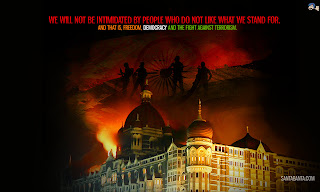
Campagne lancée par le site santabanta.com pour sensibiliser le terrorisme.


Saturday 29 November

Terror strikes Mumbai

The attacks began on Wednesday 26th November in Mumbai, during the evening. The places targeted by the gunmen were two luxury hotels, the Taj Mahal Hotel and the Oberoi Trident along with another hotel, Nariman House that included a Jewish center and a well-known restaurant, the Leopold Café. Two hospitals, Cama Hospital and Albless Hospital were also targeted along with a railway station, the Chhatrapati Shivaji Terminus. Mumbai’s attackers also laid siege to roads, taxis, cinemas, airports and other places during the next three days.

The Indian economic capital was the stage of ghastly battles involving gunmen with rucksacks containing grenades and explosives which they were using to fire indiscriminately at people on the streets and at the Indian army. The terrorists also held hostages in hotels.

The attacks were claimed by terrorists who called themselves the «Deccan Mujahideen» but this claim was later dismissed by the police who accused Pakistan. They wanted an Indian 9/11 and create fear among tourists and foreign investors.

Mumbai is no stranger to terror but it was the most devastating in terms of scale, preparation, targets and global impact. According to India's home ministry, the official death toll in Mumbai amounted to 195 dead and 295 injured. The majority of victims were Indians, at least 22 foreigners have died, including victims from Israel, the United States, Germany, Japan, Canada, Australia, Italy, Singapore, Thailand and France.


Inès.


Shocking photos:
http://www.boston.com/bigpicture/2008/11/mumbai_under_attack.html
Survivors tell their story:
http://www.ndtv.com/convergence/ndtv/video/video.aspx?id=45712
Maps of Attacks:
http://indiatoday.digitaltoday.in/comtent_image.php?name=largeimg&img=/images/stories/Pink/081128011428_CS-Mumbai-thursday_enlarge_700.jpg&id=21191&caption=
http://img372.imageshack.us/my.php?image=45250939mumbaishooting4hr0.gif
Sources :
http://news.bbc.co.uk/2/hi/south_asia/7754438.stm
http://indiatoday.digitaltoday.in/index.php?option=com_content&task=view&id=21191&Itemid=1&issueid=82&sectionid=30&latn=2&limit=1&limitstart=0 http://news.bbc.co.uk/2/hi/south_asia/7757122.stm


Samedi 29 Novembre

Attentats à Bombay

Les attaques ont commencé le mercredi 26 novembre à Mumbai, au cours de la soirée. Les lieux ciblés par les hommes armés étaient deux hôtels de luxe, l'Hôtel Taj Mahal et l'Oberoi Trident ainsi qu’un autre hôtel, le Nariman House qui comprend un centre juif. De plus, un célèbre restaurant a été victime de ces attentats, le Léopold Café, ainsi que deux hôpitaux, l'hôpital Cama et l’hôpital Albless et enfin une gare, le Chatrapati Shivaji Terminus. Les auteurs de ces attaques à Mumbai ont aussi assiégé routes, taxis, cinémas, aéroports et autres lieux au cours de ces trois derniers jours.


La capitale économique indienne a été la scène de terribles combats entre des hommes armés munis de sacs à dos contenant des grenades et des explosifs qu’ils ont utilisés au hasard sur les gens dans les rues et contre l'armée indienne. Les terroristes ont également retenu des personnes en otage dans les hôtels.
Les attaques ont été revendiquées par des terroristes qui se font appeler les «Moudjahiddins du Deccan», mais cette revendication a été rejetée par la police, qui a dénoncé l'implication du Pakistan. Ils voulaient un 11 Septembre 2001 indien pour susciter la peur parmi les touristes et les investisseurs étrangers.
Cela n’est pas la première fois que de tels attentats se produisent à Mumbai, mais ces attaques ont été les plus dévastatrices en termes d'échelle, de préparation, d’objectifs et de répercussions mondiales. Selon le ministère des Affaires intérieures, le bilan à Mumbai est de 195 morts et 295 blessés. La majorité des victimes sont indiennes, au moins 22 étrangers ont également trouvé la mort, y compris des victimes israéliennes, américaines, allemandes, japonaises, canadiennes, australiennes, italiennes, singapouriennes, thaïlandaises et françaises.

Inès.


Photos (attention certaines photos peuvent choquer):
http://www.boston.com/bigpicture/2008/11/mumbai_under_attack.html
Des survivants racontent leurs histoires:
http://www.ndtv.com/convergence/ndtv/video/video.aspx?id=45712
Cartes des différentes attaques:
http://indiatoday.digitaltoday.in/comtent_image.php?name=largeimg&img=/images/stories/Pink/081128011428_CS-Mumbai-thursday_enlarge_700.jpg&id=21191&caption=
http://img372.imageshack.us/my.php?image=45250939mumbaishooting4hr0.gif
Sources :
http://news.bbc.co.uk/2/hi/south_asia/7754438.stm
http://indiatoday.digitaltoday.in/index.php?option=com_content&task=view&id=21191&Itemid=1&issueid=82&sectionid=30&latn=2&limit=1&limitstart=0 http://news.bbc.co.uk/2/hi/south_asia/7757122.stm