lundi 2 février 2009

More blooshed in Kashmir


Saturday 13 December
More bloodshed in Kashmir

A poll is taking place at present in India to elect the Assembly. The vote will unfold in 7 stages and last 5 weeks to end on December 24 while vote count will be held on December 28.

Hundreds of people took to the street in Kashmir because the fifth phase of the election took place in Pulwama. In this disputed region, the poll is being seen as a test for the Indian government. The protesters have been marching, chanting slogans against Indian authority. The police intervened. According to a witness, the policemen didn’t seem to want to shoot at the demonstrators but a man was killed and two casualties both hit by bullets were brought to a hospital of Srinagar.
These last months Kashmir has been the scene of several pro-independent demonstrations, conflicts or riots against police forces, leaving several dead. Separatist leaders have been detained to try to prevent the organization of new protests. They however called up for a boycott of the vote and required a plebiscite to decide on the future of the State.

Polling stations were nevertheless able to work in spite of the boycott. The vote was relatively quiet with an average turnout during the first hours.

Eva
http://news.bbc.co.uk/2/hi/south_asia/7781064.stm#map


Samedi 13 Décembre
Du sang sur le Cachemire

Un scrutin se déroule actuellement en Inde pour élire l’Assemblée. Le vote se déroule en 7 phases et dure 5 semaines. Il se terminera le 24 décembre et le décompte des voix aura lieu le 28 décembre.

Dans la région du Cachemire administrée par l’Inde, les gens sont descendus par centaines dans les rues de Pulwama, où se tenait la cinquième phase du vote. Là-bas, le scrutin est perçu comme un test pour le gouvernement indien. Les protestataires ont défilé en martelant des slogans contre l’autorité indienne. La police est intervenue. Selon un témoin, les policiers semblaient ne pas vouloir tirer sur les manifestants, pourtant un homme a été tué et deux blessés par balle ont été amenés dans un hôpital de Srinagar. Le Cachemire a été témoin, ces derniers mois, de plusieurs manifestations indépendantistes et d’affrontements avec les forces de police, laissant plusieurs morts. Des leaders séparatistes sont retenus pour tenter d’empêcher l’organisation de nouvelles protestations. Ils ont cependant appelé à un boycott du vote et ont exigé un plébiscite pour décider de l’avenir de l’état.

Les bureaux de vote ont néanmoins pu fonctionner correctement malgré le boycott. Le vote a été relativement calme avec un taux de participation plutôt modéré au cours des premières heures.

Eva
http://news.bbc.co.uk/2/hi/south_asia/7781064.stm#map


vendredi 12 décembre 2008

Arrests linked to Mumbai attacks

The Taj Mahal Palace hotel was among the gunmen's targets


Sunday 7 December

Arrests linked to Mumbai attacks

On Friday, police arrested two Indian men accused of illegally buying mobile phone cards used by the gunmen in the Mumbai attacks. During the siege of the Taj Mahal hotel, the gunmen are reported to have tried to call one of the commanders of the Lashkar-e-Taiba group of Kashmiri militants. However, the messages sent by the Mumbai attackers during their assault were convoluted and vague, but the implication of their assault was devastating.

Police said another Indian citizen, Faheem Ansari, who was arrested in February in northern India carrying sketches of hotels, the train line and other sites that were later attacked, was being brought to Mumbai for renewed questioning. His training was done by former officers of the Pakistan Army whose his chief, Ashfaque Kiyani, was in close collaboration with Lashkar-e-Taiba. He was himself in contact with the ISI (Inter Service Intelligence). Rakesh Maria, a senior Mumbai police officer, said he believed there was a connection between Ansari and the Mumbai attacks. "Ansari was trained by Lashkar and sent to do reconnaissance" Maria said.

One of the arrested men, Tauseef Rahman, allegedly bought Sim cards by providing fake documents, including identification cards of dead people. Afterward, a senior police official Rajeev Kumar said that Rahman later sold them to Ahmed. Both men were arrested on Friday and charged with fraud and conspiracy.

Security officials demanded the release of one of them, Mukhtar Ahmed, saturday, claiming he was a local police officer who may have been on an undercover mission. Ahmed was from the Indian portion of Kashmir, the disputed Himalayan region at the root of much of the tension between India and Pakistan.

Thus investigators are looking for connections as well as militants from Bangladesh and Pakistan. But, Pakistan's government has strongly denied any involvement in the Mumbai attacks. Its Foreign Minister, Shah Mahmood Qureshi, said his country would co-operate with India to "combat terrorism in all its forms and manifestations".


Cindy

http://news.bbc.co.uk/2/hi/south_asia/7768770.stm
http://timesofindia.indiatimes.com/India/Two_more_arrested_for_Mumbai_terror_attacks/articleshow/3800470.cms
http://edition.cnn.com/2008/WORLD/asiapcf/12/06/mumbai.attack.investigation/
http://www.guardian.co.uk/commentisfree/2008/dec/05/mumbai-terror-attacks-terrorism


Dimanche 7 Décembre

Deux hommes arrêtés après les attentats de Bombay

Vendredi, la police a arrêté deux Indiens accusés d'avoir acheté illégalement des cartes Sim utilisées par les terroristes dans les attentats de Bombay. Au cours du siège de l'hôtel Taj Mahal, ils auraient tenté d'appeler l'un des commandants du groupe Lashkar-e-Taiba basé au Cachemire. Cependant, il faut toutefois préciser que la teneur des messages restait vague et alambiquée.

La police a également annoncé qu'un autre citoyen indien, Faheem Ansari, qui avait été arrêté en février dans le nord de l'Inde en possession de croquis d'hôtels et de cartes du réseau ferroviaire, a été réinterrogé à Bombay suite aux attentats. Il a été entraîné par d'anciens officiers de l'armée pakistanaise dont le chef, Ashfaque Kiyani, était en étroite collaboration avec Lashkar-e-Taiba. Ce dernier était lui-même en contact avec l'ISI (Inter Service Intelligence) les services secrets pakistanais. Rakesh Maria, un haut fonctionnaire de la police de Bombay, a annoncé qu'il croyait qu’un lien entre Ansari et les attentats de Bombay existait. "Ansari a été formé par Lashkar et envoyé à Bombay dans un objectif de reconnaissance et de préparation», a-t-il déclaré.

L'un des hommes arrêtés, Tauseef Rahman, aurait acheté des cartes Sim en fournissant de faux documents, y compris des cartes d'identité de personnes décédées. Par la suite, un haut fonctionnaire de police Rajeev Kumar a annoncé que Rahman les aurait par la suite vendues à Ahmed. Les deux hommes ont été arrêtés vendredi et inculpé de fraude et de complot.

Les responsables de la sécurité ont exigé la libération de l'un d'eux, Mukhtar Ahmed, samedi, prétendant qu'il était un agent de police local en mission d'infiltration. Ahmed a travaillé dans la région indienne du Cachemire, la région himalayenne contestée à l'origine d'une grande partie de la tension entre l'Inde et le Pakistan.

Ainsi, les enquêteurs cherchent un lien avec le Bangladesh et le Pakistan. Mais, le gouvernement du Pakistan a fermement nié toute implication dans les attentats de Bombay. Son ministre des Affaires étrangères, Shah Mahmood Qureshi, a déclaré que son pays allait coopérer avec l'Inde afin de "combattre le terrorisme sous toutes ses formes et manifestations".


Cindy

http://news.bbc.co.uk/2/hi/south_asia/7768770.stm
http://timesofindia.indiatimes.com/India/Two_more_arrested_for_Mumbai_terror_attacks/articleshow/3800470.cms
http://edition.cnn.com/2008/WORLD/asiapcf/12/06/mumbai.attack.investigation/
http://www.guardian.co.uk/commentisfree/2008/dec/05/mumbai-terror-attacks-terrorism

mardi 9 décembre 2008

Terror strikes Mumbai


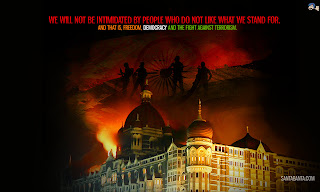
Campagne lancée par le site santabanta.com pour sensibiliser le terrorisme.


Saturday 29 November

Terror strikes Mumbai

The attacks began on Wednesday 26th November in Mumbai, during the evening. The places targeted by the gunmen were two luxury hotels, the Taj Mahal Hotel and the Oberoi Trident along with another hotel, Nariman House that included a Jewish center and a well-known restaurant, the Leopold Café. Two hospitals, Cama Hospital and Albless Hospital were also targeted along with a railway station, the Chhatrapati Shivaji Terminus. Mumbai’s attackers also laid siege to roads, taxis, cinemas, airports and other places during the next three days.

The Indian economic capital was the stage of ghastly battles involving gunmen with rucksacks containing grenades and explosives which they were using to fire indiscriminately at people on the streets and at the Indian army. The terrorists also held hostages in hotels.

The attacks were claimed by terrorists who called themselves the «Deccan Mujahideen» but this claim was later dismissed by the police who accused Pakistan. They wanted an Indian 9/11 and create fear among tourists and foreign investors.

Mumbai is no stranger to terror but it was the most devastating in terms of scale, preparation, targets and global impact. According to India's home ministry, the official death toll in Mumbai amounted to 195 dead and 295 injured. The majority of victims were Indians, at least 22 foreigners have died, including victims from Israel, the United States, Germany, Japan, Canada, Australia, Italy, Singapore, Thailand and France.


Inès.


Shocking photos:
http://www.boston.com/bigpicture/2008/11/mumbai_under_attack.html
Survivors tell their story:
http://www.ndtv.com/convergence/ndtv/video/video.aspx?id=45712
Maps of Attacks:
http://indiatoday.digitaltoday.in/comtent_image.php?name=largeimg&img=/images/stories/Pink/081128011428_CS-Mumbai-thursday_enlarge_700.jpg&id=21191&caption=
http://img372.imageshack.us/my.php?image=45250939mumbaishooting4hr0.gif
Sources :
http://news.bbc.co.uk/2/hi/south_asia/7754438.stm
http://indiatoday.digitaltoday.in/index.php?option=com_content&task=view&id=21191&Itemid=1&issueid=82&sectionid=30&latn=2&limit=1&limitstart=0 http://news.bbc.co.uk/2/hi/south_asia/7757122.stm


Samedi 29 Novembre

Attentats à Bombay

Les attaques ont commencé le mercredi 26 novembre à Mumbai, au cours de la soirée. Les lieux ciblés par les hommes armés étaient deux hôtels de luxe, l'Hôtel Taj Mahal et l'Oberoi Trident ainsi qu’un autre hôtel, le Nariman House qui comprend un centre juif. De plus, un célèbre restaurant a été victime de ces attentats, le Léopold Café, ainsi que deux hôpitaux, l'hôpital Cama et l’hôpital Albless et enfin une gare, le Chatrapati Shivaji Terminus. Les auteurs de ces attaques à Mumbai ont aussi assiégé routes, taxis, cinémas, aéroports et autres lieux au cours de ces trois derniers jours.


La capitale économique indienne a été la scène de terribles combats entre des hommes armés munis de sacs à dos contenant des grenades et des explosifs qu’ils ont utilisés au hasard sur les gens dans les rues et contre l'armée indienne. Les terroristes ont également retenu des personnes en otage dans les hôtels.
Les attaques ont été revendiquées par des terroristes qui se font appeler les «Moudjahiddins du Deccan», mais cette revendication a été rejetée par la police, qui a dénoncé l'implication du Pakistan. Ils voulaient un 11 Septembre 2001 indien pour susciter la peur parmi les touristes et les investisseurs étrangers.
Cela n’est pas la première fois que de tels attentats se produisent à Mumbai, mais ces attaques ont été les plus dévastatrices en termes d'échelle, de préparation, d’objectifs et de répercussions mondiales. Selon le ministère des Affaires intérieures, le bilan à Mumbai est de 195 morts et 295 blessés. La majorité des victimes sont indiennes, au moins 22 étrangers ont également trouvé la mort, y compris des victimes israéliennes, américaines, allemandes, japonaises, canadiennes, australiennes, italiennes, singapouriennes, thaïlandaises et françaises.

Inès.


Photos (attention certaines photos peuvent choquer):
http://www.boston.com/bigpicture/2008/11/mumbai_under_attack.html
Des survivants racontent leurs histoires:
http://www.ndtv.com/convergence/ndtv/video/video.aspx?id=45712
Cartes des différentes attaques:
http://indiatoday.digitaltoday.in/comtent_image.php?name=largeimg&img=/images/stories/Pink/081128011428_CS-Mumbai-thursday_enlarge_700.jpg&id=21191&caption=
http://img372.imageshack.us/my.php?image=45250939mumbaishooting4hr0.gif
Sources :
http://news.bbc.co.uk/2/hi/south_asia/7754438.stm
http://indiatoday.digitaltoday.in/index.php?option=com_content&task=view&id=21191&Itemid=1&issueid=82&sectionid=30&latn=2&limit=1&limitstart=0 http://news.bbc.co.uk/2/hi/south_asia/7757122.stm

dimanche 30 novembre 2008

Naval Battle in the Gulf of Aden


Sunday 23 November
Naval Battle in the Gulf of Aden

India is currently patrolling with several other countries like France, South Korea, Russia, Spain, United States and NATO in the Gulf of Aden which connects the Red Sea and the Indian Ocean, the majority of the surface belong to Somalia. With more than 90 ships attacked this year, the requests for action against the piracy are increasing.

So on October 23rd India deployed the INS Tabar which escorted 35 boats in the Gulf of Aden. On Tuesday, November 18th, an Indian warship sank a mother ship suspected of piracy. Earlier in the week, the super tanker Sirius Star was hijacked with 25 crew. The ship was laden with oil. The value of the load is estimated at 100 million dollars. The ship is anchored near the coast of Somalia. The Directorate General of Shipping in India confirmed that seven Indians were part of the crew of the MV Delight, a hijacked Iranian cargo ship. The ship contained some wheat and was heading to Iran.

According to the Indian media, the Indian navy is planning to send next week at least another warship to the sector, probably the destroyer INS Mysore. The Indian navy refused to comment. The UN Security Council authorized, to enter the territorial waters of Somalia for six months “to repress acts of piracy and armed robbery at sea".

Eva

http://news.bbc.co.uk/2/hi/south_asia/7741287.stm


Dimanche 23 Novembre
Bataille navale dans le Golfe d’Aden

L’Inde patrouille actuellement avec plusieurs autres pays dans le Golfe d’Aden. Le Golfe d’Aden relie la Mer Rouge et l’Océan Indien, la majorité de la surface surveillée appartient à la Somalie. La France, la Corée du Sud, la Russie, l'Espagne, les Etats Unis et l'OTAN sont également présents sur place. Avec plus de 90 navires attaqués cette année, les demandes d’action contre les pirates vont croissant.

L’Inde a donc déployé, le 23 octobre, le navire INS Tabar qui a escorté 35 bateaux dans les eaux du Golfe d’Aden. Mardi 18 novembre, un vaisseau de guerre indien a coulé un ravitailleur soupçonné de piraterie. Au début de la semaine, un navire-citerne saoudien, le Sirius Star avait été détourné avec 25 membres d’équipage. Le navire transportait une cargaison de pétrole estimée à 100 millions de dollars. Le navire est actuellement ancré près des côtes somaliennes.
D’autre part, le directeur général de la marine indienne a confirmé que sept Indiens faisaient partie de l’équipage du MV Delight, un cargo iranien détourné. Le navire contenait du blé et se dirigeait vers l’Iran.

Selon les médias, la marine indienne prévoit d'envoyer encore au minimum un vaisseau de guerre dans le secteur. On pense au déploiement d’un destroyer, l’ INS Mysore dès la semaine prochaine. La marine refuse cependant de commenter. L’ONU a autorisé, pour une durée de six mois, l’entrée dans les eaux territoriales de la Somalie pour «réprimer les actes de piraterie et les attaques en mer.»

jeudi 27 novembre 2008

Of Cows and Men


Sunday 16 November

Of Cows and Men

Animals have been given a central role in Indian traditions, specifically for Hindu people. There is perhaps no more stereotypical image of India than seeing a cow wandering in the middle of an Indian city.

Hindus considers cows as sacred animals and their cutting down is banned throughout most of India. So, cows are frequently allowed to wander where they please, even in cities.

Economic development and modern life do not smoothly coexist with century traditions. In New Delhi, many residents have lost patience with the thousands of stray cattle.

In 2002, following several lawsuits, judges finally ordered the cattle cleared from the roads. However, six years later, cows are still here. The government promised that it was going to resolve this problem before the Commonwealth Games, which will be held in New Delhi in 2010.

« Cow catchers », called cow-boys, are formed to catch the wandering animals. However, they face difficulties related to the dangerousness of the animals. In general, citizens keep a neutral attitude, but sometimes, the cow catchers need to deal with the anger of drivers when roads are closed to catch cows. Once a cow is caught, it is driven out of the city and fitted with a microchip for further tracking.

Over the past two years, the city government claims that more than 20,000 cows have been taken off the street, current studies estimate that about 5,000 to 12,000 cows still wander in cities.


Cindy

http://www.nytimes.com/2008/11/05/world/asia/05india.html?_r=2&oref=slogin&oref=slogin


Dimanche 16 novembre

Sacrées vaches

Les animaux occupent une place importante dans les traditions indiennes et spécialement pour les Hindous. Voir une vache en liberté au beau milieu d'une ville indienne n’est pas qu’un cliché.

Les Hindous considèrent les vaches comme sacrées et leur abattage est interdit dans pratiquement tout le pays. Ainsi, les vaches sont souvent autorisées à se promener où bon leur semble, y compris en ville.

Le développement économique et la vie moderne ne coexistent pas de façon harmonieuse avec les traditions. À New Delhi, de nombreux habitants n’ont plus la patience de supporter ce bétail en goguette.

En 2002, après plusieurs procès, les juges ont finalement ordonné l'interdiction du bétail dans les villes. Cependant, six ans plus tard, les vaches sont toujours là. Le gouvernement a promis qu'il allait résoudre ce problème avant les Jeux du Commonwealth, qui se dérouleront à New Delhi en 2010.

Des attrapeurs de vaches, appelés cow-boys, sont formés pour récupérer ces vaches errantes. Cependant, ils se heurtent à des difficultés liées à la dangerosité des animaux. En général, les citoyens conservent une attitude neutre, mais parfois, les attrapeurs doivent faire face à la colère des conducteurs lorsque les routes sont fermées pour capturer ces vaches. Une fois capturée, la vache est équipée d’une puce électronique afin de pouvoir la suivre et chassée de la ville.

Au cours des deux dernières années, le gouvernement déclare avoir pris plus de 20000 vaches de rue, mais il en reste encore selon les estimations de 5000 à 12000.


Cindy


http://www.nytimes.com/2008/11/05/world/asia/05india.html?_r=2&oref=slogin&oref=slogin

dimanche 23 novembre 2008

TATA un des plus riches indiens avec sa voiture la moins chère au Monde: il a racheté une des marques les plus luxueuse (Jaguard).


Friday 7 November,
The new Maharajas (Rupies and Luxuries)

With India's booming economy, far from the slums of big cities, the nouveaux-riches, millionaires and billionaires have made their apparition. They are role models for success for each Indian and inspire them to become more entrepreneurial.
They are also the new hopes of a country which yearns to become a super-power. They are businessmen or celebrities; they make one billion inhabitants dream.
In 2006, there were 27 Indian billionaires and today, in 2008, they are 53 according to Forbes Magazine. India is the new hub of rich people, second best to Russia in Asia.

Like Maharajas, they love luxuries and a lot of foreign famous brands invest on the Indian market which is one of the most enticing growth markets to attract this new kind of customers. The brands love India: their strong presence are felt (Louis Vuitton, Hermes, Cartier, Prada, Chanel...) and Indians welcome luxury products. Three ultra-luxury malls will open in Mumbai in 2009.

Inès.

http://www.time.com/time/magazine/article/0,9171,501060410-1179415,00.html


L'économie indienne est en train de connaître un boom sans précédent.
Loin des bidonvilles des grandes villes, les nouveaux riches, millionaires et milliardaires font leur apparition.
Ils sont dans leur pays, des modèles de réussite pour chaque Indien et les inspirent à devenir plus entreprenants.
Ils sont aussi les nouveaux espoirs d'un pays qui espère devenir une puissance mondiale. Hommes d'affaires ou célébrités, ils font rêver un milliard d'habitants.
En 2006, il y avait 27 milliardaires indiens, aujourd'hui, en 2008, ils sont 53 selon le magazine Forbes. L'Inde est le nouveau pôle des riches, le plus important en Asie après la Russie.

Comme des Maharajas, ils aiment les choses luxueuses et les grandes marques.
Plusieurs marques étrangères investissent sur le marché indien qui est l'un des marchés qui connaît le plus fort taux de croissance, afin d'attirer ce nouveau genre de clients.
Les marques aiment l'Inde: leur présence est très bien ressentie Louis Vuitton, Hermès, Cartier, Prada, Chanel et les Indiens accueillent favorablement les produits de luxe.
Trois centres commerciaux ultra luxueux ouvriront à Mumbai, en 2009.

Inès.

http://www.time.com/time/magazine/article/0,9171,501060410-1179415,00.html

http://www.forbes.com/lists/2008/10/billionaires08_The-Worlds-Billionaires_Rank.html

http://economictimes.indiatimes.com/News/News_By_Industry/Cons_Products/Fashion__CosmeticsJewellery/Indias_tryst_with_luxury_brands/rssarticleshow/2367312.cms
http://www.thehindubusinessline.com/catalyst/2004/10/21/stories/2004102100150300.htm

http://economictimes.indiatimes.com/News/News_By_Industry/Services/Retailing/Are_luxury_brands_malls_future_of_Indian_economy/articleshow/3611709.cms
http://news.bbc.co.uk/2/hi/business/6312195.stm

dimanche 26 octobre 2008

India in space

Sunday 26 October

India in space

Early Wednesday, India joined the circle of the space powers by sending its first spacecraft in orbit around the moon. The spacecraft called « Chandrayaan-1 » was launched from an island which is located south of Andhra Pradesh.

The mission is going to last two years and it's supposed to work out a three dimension map of the surface of the Moon. The spacecraft will prospect the lunar surface and try to find some natural resources. At the same time, Chandrayaan-1 will estimate the mineral composition of the moon.

In 2007, China launched its first space mission. China and India are in permanent competition. A member of government said « China has gone earlier, but today we are trying to catch up with them and bridge the gap » The moon mission is supposed to show to the world the capacities of India because space is a way to show the power of a country. But according to Bharat Karnad a strategic affairs analyst, India can ill afford to waste money on prestige projects.

Eva

Dimanche 26 Octobre

L'Inde arrive dans l'espace

Mercredi à l’aube, l'Inde
a rejoint le cercle des puissances spatiales en lançant son premier vaisseau spatial en orbite autour de la Lune. La fusée nommée « Chandrayaan-1» a été lancée depuis une île au sud de l'Andhra Pradesh.

La mission, qui durera deux ans, est censée établir une carte en trois dimensions de la surface de la Lune. Le vaisseau va chercher des ressources naturelles. En même temps, Chandrayaan-1 étudiera la composition minéralogique de la surface de la lune.

En 2007, la Chine a effectué sa première mission dans l'espace. La Chine et l'Inde sont en compétition permanente. Selon un membre du gouvernement: « La Chine y est allé plus tôt, mais aujourd'hui nous essayons de les rattraper et de combler le fossé » La mission lunaire est censée montrer au monde les capacités de l'Inde car le domaine spatial est un moyen de prouver la puissance d'un pays. Mais selon Bharat Karnad, chercheur et expert en sciences politiques, l’Inde n’a pas les moyens de s’offrir de tels projets de prestige.

Eva